For years, it was not always easy for the industry to talk about recycled, reclaimed or reclaimed materials. Although many of these solutions already offered technical guarantees, efficiency and real environmental benefits, many companies preferred not to highlight them publicly.
In traditional industrial sectors, “recycled” still carried with it certain prejudices associated with quality, performance or prestige. Silence was, for many, a way of avoiding uncomfortable explanations or misinterpretations.
However, the context has changed dramatically. Today, companies not only integrate environmental criteria into their operations, but also seek to demonstrate their commitment to the circular economy and positive impact. Sustainability has gone from being a secondary issue to becoming part of corporate reputation. In this scenario, a concept appears that helps to understand part of this evolution: greenhushing, also known as “green silence”.
When companies preferred not to talk about sustainability
Greenhushing describes the decision of some organizations to minimize or avoid communicating their sustainable initiatives, even when these actions are real.
Unlike greenwashing, which exaggerates environmental commitments, greenhushing arises precisely from the fear of communicating. Many companies have avoided talking about sustainability for various reasons:
– Fear of criticism.
– Fear of being accused of greenwashing.
– Regulatory uncertainty.
– It was felt that the market was not yet ready.
For years, it was common in many industrial sectors for some companies to avoid highlighting the use of regenerated, recycled or recovered materials. This was not necessarily a question of quality or performance, but of perception: circular was still unfairly associated with a lower-value alternative.
Paradoxically, these solutions already provided very relevant technical, economic and environmental advantages such as waste reduction, resource utilization, lower consumption of raw materials and a clear contribution to the circular economy. What was missing was not sustainability. What was missing was the confidence to communicate it.
The paradigm shift in industrial sustainability
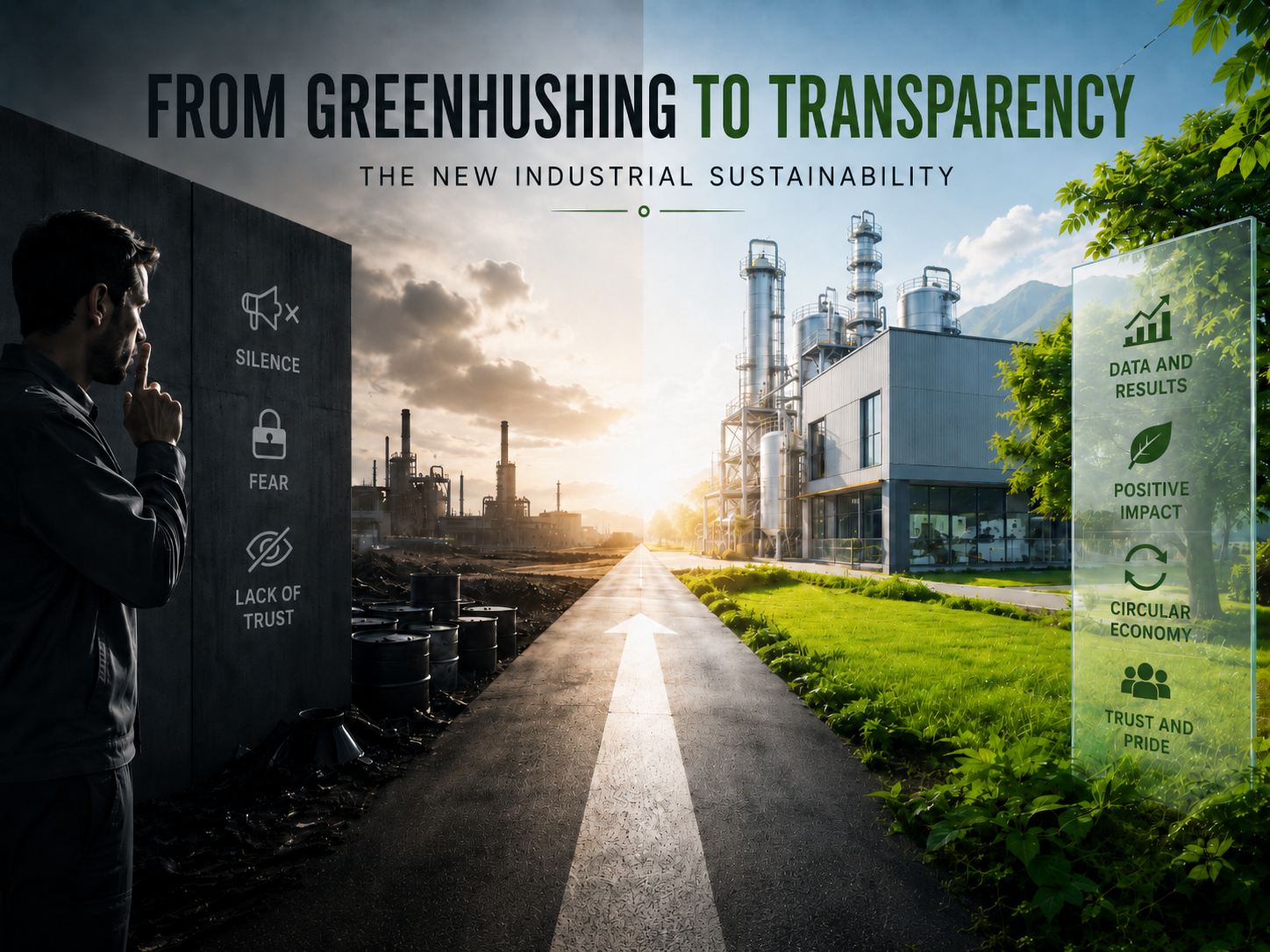
The transformation of recent years has been profound. Today, companies understand that incorporating regenerated, recycled or circular solutions does not represent a competitive weakness. On the contrary, it has become a sign of innovation, responsibility and vision for the future. In sectors such as industry, more and more organizations are openly communicating that they use reclaimed materials and are proud of it.
This change reflects a very clear cultural evolution:
– From concealment to transparency.
– From reputational fear to differential value.
– From greenhushing to a more mature and coherent communication.
Sustainability is no longer perceived only as a regulatory obligation. It is also a strategic tool capable of generating trust, reputation and differentiation.
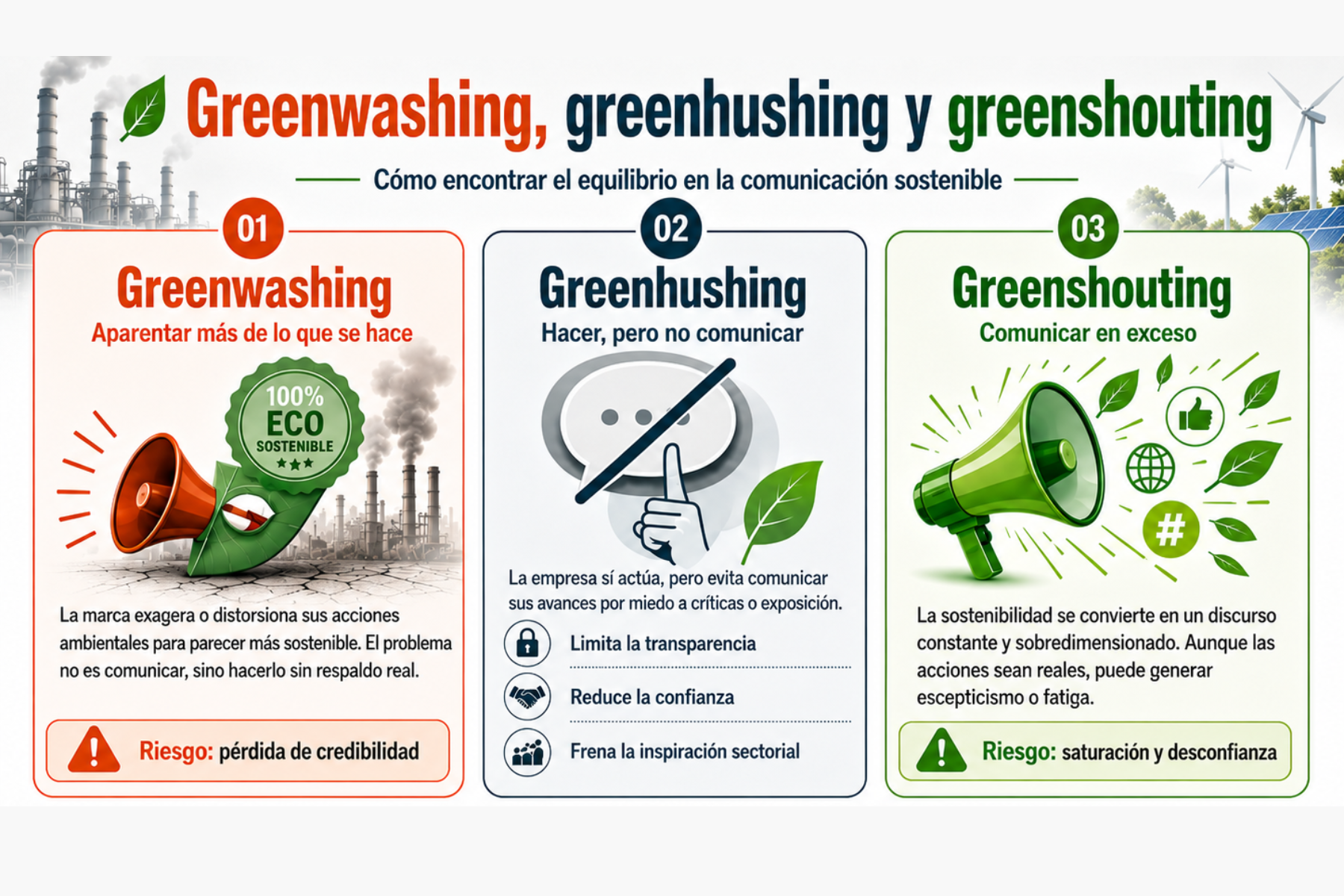
Greenwashing, greenhushing and greenshouting: finding the balance
The evolution of sustainable communication has also brought new challenges. Today, three phenomena coexist and companies must learn to manage them.
Greenwashing: appearing more than you do
Greenwashing occurs when a brand exaggerates or distorts its environmental actions to project a more sustainable image than it really is. The problem is not communicating sustainability, but doing so without real support.
Greenhushing: doing, but not communicating
At the other extreme is greenhushing. Companies do develop sustainable initiatives, but prefer not to talk about them to avoid criticism or exposure. While this may seem a prudent strategy, it also has significant risks:
– Limits transparency.
– Reduces confidence.
– It makes it difficult for other companies to draw inspiration from actual good practices.
Greenshouting: over-communicating
There is also a third phenomenon: greenshouting. Here, companies turn sustainability into a constant and overstated discourse. Even if the actions are legitimate, overexposure can generate skepticism or fatigue among consumers and stakeholders.
Neither greenwashing nor greenhushing: communicating sustainability with credibility
The evolution of sustainability has also changed the way companies communicate. For years, the focus was on combating greenwashing: practices that exaggerate or distort environmental commitments to project a more sustainable image than is actually the case. In response, many organizations opted for the opposite extreme: to stop communicating their progress for fear of public scrutiny. This is where green hushing comes in.
However, the current challenge is not to choose between exaggeration and silence. The real challenge lies in building honest, verifiable communication strategies aligned with real actions. In addition, the new European regulatory context demands greater transparency in environmental claims. Companies need to back up their messages with data, metrics and concrete evidence. This is helping to professionalize sustainable communication and build greater trust among consumers, investors and partners. Because the circular economy is no longer hidden. Today it is part of a new, more open, transparent and forward-looking industrial culture.