Meeting ESG (environmental, social and governance) objectives has become a priority for companies. Investors, ESG rating agencies and European regulation itself are demanding increasingly specific commitments and objectives.
Industrial waste management is a lever to advance these ESG objectives. Specifically, the regeneration of used industrial oil allows the generation of measurable, traceable environmental data that can be easily incorporated into the sustainability reporting of any industrial company.
What are ESG criteria and why do they matter to your company?
ESG criteria evaluate a company’s performance in three areas: environmental impact, relationship with the social environment and quality of corporate governance. These ESG factors are today a reference standard for investors, banks and corporate clients when assessing the risk and soundness of an organization.
This approach is closely linked to the sustainable development goals (SDGs) promoted by the United Nations, and to the philosophy of socially responsible investment, which integrates environmental, social and good governance criteria into investment decisions.
For industrial companies, meeting these ESG objectives conditions access to financing, relationships with clients who demand environmental criteria from their suppliers, and their position before ESG rating agencies.
The specific weight of hazardous waste management
Within the environmental criteria of the ESG objectives, waste management occupies a key place. Used industrial oil is a hazardous waste whose final destination (regeneration, energy recovery or disposal) has a very different impact on sustainability depending on its final management.
Regenerating used oil, instead of disposing of it in other ways, provides specific environmental benefits:
– Reduces the consumption of non-renewable natural resources by avoiding oil extraction.
– Contributes to a circular economy model, by transforming waste into raw material for new lubricants.
– Helps reduce the carbon footprint associated with the product’s life cycle.
This data fits naturally into the environmental axis (E) of any ESG strategy and can be reported following frameworks such as the GRI (Global Reporting Initiative) or the requirements of the European CSRD regulations.
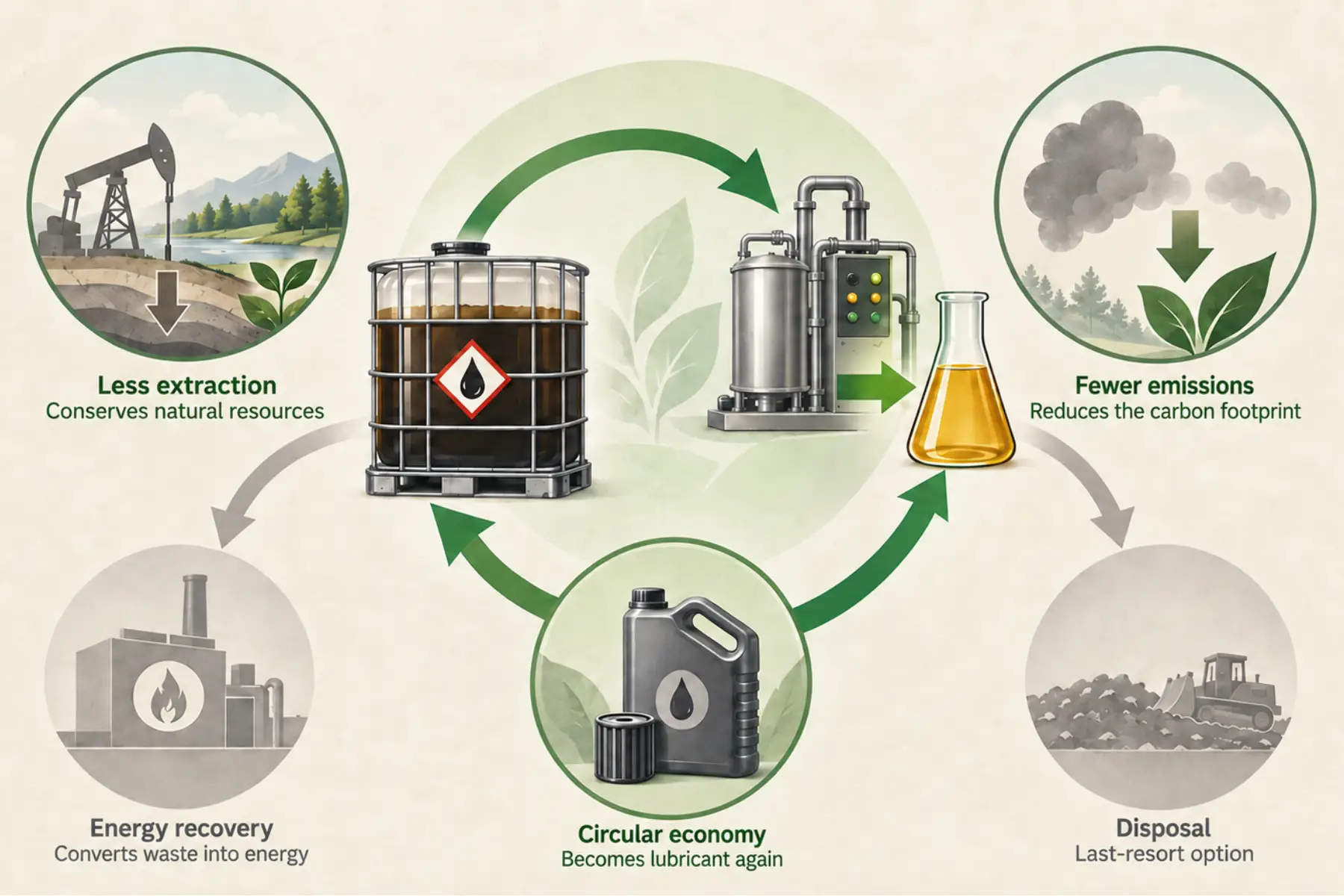
Regeneration converts hazardous waste into a circular resource.
How to integrate this data into your sustainability reporting
For used oil regeneration to have real weight in your ESG objectives, it is advisable to systematically incorporate some data into the sustainability report:
– Total volume of oil used managed during the period.
– Percentage intended for regeneration compared to other treatment routes.
– Traceability documentation, from collection to final destination.
– Estimation of the avoided environmental impact, when a verified calculation methodology exists.
Having a supplier that provides this information in a structured way simplifies the work of sustainability departments, which thus avoid having to manually reconstruct the history of waste managed in each reporting exercise.
Strategic benefits of aligning waste management with ESG objectives
Beyond regulatory compliance, integrating used oil regeneration into your ESG strategy provides advantages that are of interest to both sustainability and financial management:
– Reduction of regulatory and reputational risks linked to poor management of hazardous waste.
– Better positioning with investors and customers who demand verifiable ESG criteria in their supply chain.
– Consistent data for sustainability ratings, increasingly decisive in purchasing and financing processes.
– Consistency with the ESG factors that banks, insurers and large industrial clients already evaluate.
Why use a specialized supplier?
Not all waste managers offer the same level of traceability or the same ability to generate useful information for reporting. A supplier specialized in used industrial oil regeneration, with certified processes and accessible data, allows sustainability departments to work with reliable information without dedicating internal resources to reconstructing the data.

This is one of the reasons why companies with demanding ESG objectives choose specialized providers instead of generic managers: the quality of the final data depends directly on the quality of the management process.
Advancing your ESG goals does not necessarily require large additional investments. The regeneration of used industrial oil is one of those operational decisions that, well managed and documented, generate a real and measurable impact on the three axes of corporate sustainability: environmental, social and governance.